
Lamia Tazi Chairwoman & CEO · Sothema Contact

Insights & Perspectives

Five arguments about
an industry

Analytical essays on the questions that define Lamia Tazi’s professional field. These are editorial analyses written for this website, drawing on her documented positions and on published research — not statements attributed to her.

Lamia Tazi speaking into a microphone during a broadcast interview

Contents

  1. Essay 01
    What pharmaceutical sovereignty actually costs — the four layers, and why only one of them is usually built
  2. Essay 02
    Biosimilars and the arithmetic of access — why a manufacturing decision changes who receives treatment
  3. Essay 03
    Succession in a listed family company — the problem most founders never solve
  4. Essay 04
    Contract manufacturing as industrial policy — how making other people’s medicines builds a country’s own
  5. Essay 05
    The constraint is people, not plants — the input that takes longest and is funded last

Essay 01 · Health Security

What pharmaceutical sovereignty actually costs

Monochrome portrait of Lamia Tazi

“Sovereignty” is one of the most-used words in health policy since 2020, and one of the least costed. In manufacturing terms it has a precise content, and the price of each component is known.

Lamia Tazi’s formulation of the problem is unusually direct: Covid, she has said, was a real crash test, and it showed what happens when you do not have pharmaceutical sovereignty. What follows is an attempt to set out what that sovereignty consists of.

Layer one: formulation capacity

This is the layer everyone builds first, because it is the most visible. A plant that can turn active ingredients into finished medicines — tablets, capsules, sterile injectables, biologicals. It is capital-intensive but tractable: the technology can be purchased, the plant can be built, the standards are documented.

Africa has roughly 690 such plants. The difficulty is that they are concentrated: eight countries account for about 85% of them, and typical capacity utilisation runs between 30 and 60 per cent, against more than 70 per cent in developed economies. Half-empty plants are expensive plants, and expensive plants lose to imports, which keeps them half-empty.

Layer two: ingredient security

This is the layer almost nobody builds, and it is the one that determines whether the first layer means anything. More than 95% of the active pharmaceutical ingredients used on the continent are imported, mainly from India and China.

A country can manufacture every finished dose it consumes and remain entirely dependent, because the molecule at the centre of every one of those doses arrives by sea. Closing that gap requires a fine chemicals and fermentation industry — a different sector, with different economics, longer payback and environmental requirements that pharmaceutical formulation does not face. It is the honest reason sovereignty remains partial almost everywhere outside a handful of countries.

Layer three: regulatory capability

A plant cannot supply what a regulator cannot approve. Assessing a biosimilar dossier requires reviewers competent in comparability science; inspecting an aseptic facility requires inspectors who have seen one operating properly. Where that capability is thin, capable manufacturers are throttled by incapable approval systems — and the African Medicines Agency exists precisely to pool this scarce expertise across the continent.

Layer four: people

Formulation scientists, bioprocess engineers, analytical chemists, qualified persons, regulatory affairs professionals. This layer takes the longest to build — a decade from first-year undergraduate to competent independent practitioner — and it is the one most often assumed rather than funded.

The uncomfortable conclusion

Sovereignty is not achieved by a policy announcement or by a single plant. It is achieved by four simultaneous, expensive, decade-scale programmes, of which the visible one is the easiest.

Morocco’s position — roughly 65% of domestic demand met locally, exports reaching more than seventy countries — was assembled over five decades. Sothema was founded in 1976 and was producing insulin at Bouskoura by the early 1980s. That is the realistic timescale, and it is worth stating plainly whenever the word is used.
Essay 02 · Access Economics

Biosimilars and the arithmetic of access

There is a number in Lamia Tazi’s published remarks that deserves more attention than it usually gets: through its oncology biosimilars, Sothema reaches six times more patients than the originator products had reached before.

Six times. Same quality, a fraction of the cost. In most industries a figure like that describes market share. In oncology it describes something else entirely.

Why the multiple exists at all

Originator biological medicines are priced against the reimbursement capacity of high-income health systems. That pricing is not arbitrary — it reflects genuine research cost and genuine risk — but it is calibrated to a payer that does not exist in most of the world.

When such a medicine reaches a middle-income or lower-income health system at that price, the result is not reduced uptake. It is rationing, formal or informal: treatment restricted to narrow indications, to later lines, to patients who can pay privately, or simply not funded at all. The demand curve does not bend gently. It falls off a cliff.

A biosimilar priced against local manufacturing economics moves the treatment back inside the affordable range, and the population that can be treated expands by a multiple rather than a margin.

Why almost nobody in the region does it

Biosimilars are the hardest useful thing a pharmaceutical manufacturer can attempt. A conventional generic can be made chemically identical to the original. A biological medicine cannot, because it is produced by living cells and no two production systems yield structurally identical molecules.

What a biosimilar developer must demonstrate instead is that its product is highly similar to the reference, with no clinically meaningful differences in safety, purity or potency. That requires cell-line development, upstream and downstream bioprocessing, extensive analytical characterisation, comparative clinical work and aseptic fill-finish — each a discipline of its own, and each subject to inspection.

The capital and capability thresholds are why biosimilar manufacture is concentrated in a small number of countries, and why a manufacturer in Bouskoura doing it at all is a structural event rather than a commercial one.

The decision was taken years earlier

The important point about the sixfold figure is that it was determined long before the product launched. It was determined when the aseptic capability was funded, when the technology-transfer partnerships were negotiated, and when the company chose to keep investing in biologics through periods when nothing about that choice looked commercially obvious.

Sothema’s trajectory into biologics began with insulin in the early 1980s. Forty years of accumulated aseptic and biological capability is what a sixfold access multiple actually rests on.

Essay 03 · Governance

Succession in a listed family company


Founder succession is the most reliably mishandled event in the life of a family-controlled business. It is not usually mishandled through bad faith. It is mishandled because the founder and the board are trying to answer two different questions at once, and only one of them can be answered cleanly.

The first question is about knowledge: how do we keep four decades of judgement about markets, regulators, partners and people inside the company? The second is about authority: who now decides?

Conflating them produces the three familiar failure modes. The shadow founder, who steps back formally and continues to decide informally, leaving a successor who governs an organisation that does not fully report to them. The hollow appointment, where the title transfers and the authority does not, and every significant decision is escalated until the company stalls. And the clean break, which answers the authority question perfectly and throws away the knowledge.

What a listing changes

In a private family company these ambiguities can persist for years, because nobody outside needs to know who actually decides. A listed company does not have that luxury. Sothema has been listed on the Casablanca Stock Exchange since 2005 — the first North African pharmaceutical company to go public. Its governance arrangements are disclosed, its results are periodic, and its acquisitions are announced to a market that will price them.

That constraint is usually described as a burden. In a succession it is closer to a discipline: it forces the two questions apart, because both answers have to be stated publicly.

The 2019 arrangement

Sothema’s board separated them explicitly. Executive authority passed completely to Lamia Tazi as Chairwoman of the Board and Chief Executive Officer. The founder’s strategic judgement was retained, but relocated into a newly created strategic committee, chaired by him, with a stated remit to define and monitor the group’s strategic orientations — advisory in character, and structurally distinct from executive command.

Two offices, two remits, one line of authority. The knowledge stays; the decision moves.

Why the appointment was defensible

Structure alone does not make a succession work. The successor has to be credible to a market as well as to a family, and internal family appointments face a particular scepticism that is not always unfair.

The record answered it. Twenty-two years inside the company before the chairmanship. The statutory office of responsible pharmacist held personally, in a role where errors are attributable to a named individual rather than diffused across a committee. A period of operating leadership during which turnover is reported to have multiplied more than sixfold, and the company advanced from 165th to 57th among Morocco’s 500 largest enterprises.

That is an internal promotion argued on demonstrated performance. It is the version of family succession that works — and it is worth noticing how much of the work was done in the two decades before the appointment rather than in the announcement of it.

Essay 04 · Industrial Policy

Contract manufacturing as industrial policy

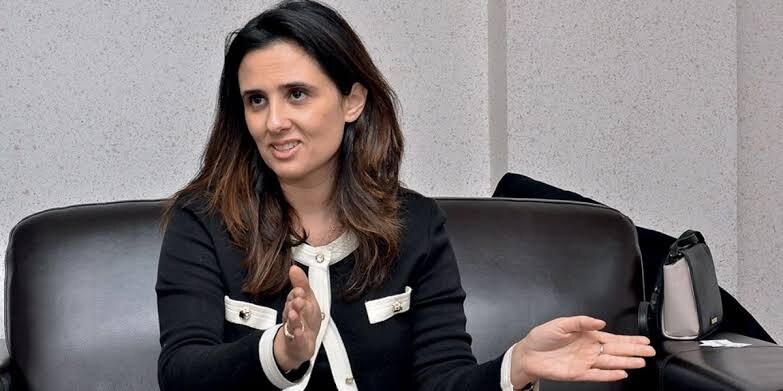
Lamia Tazi in conversation during a seated business meeting

Contract manufacturing is usually described as a low-margin service business — renting out capacity to companies who own the valuable part. That reading misses what it does to the plant doing the renting.

Sothema manufactures under contract for more than thirty-five national and international laboratories, reported to include major research-driven groups. Its own portfolio runs alongside that work in the same facilities, under the same quality system, operated by the same people.

Three things that move in the wrong direction

The commercial flow is outward: product leaves, fees arrive. But three other things flow inward, and they are the reason the arrangement is strategic.

Audit pressure. A multinational principal audits its contract manufacturer to its own global standard, repeatedly, with the power to withdraw the work. Passing those audits year after year forces a quality system to a level that domestic regulation alone would not require. That level then applies to everything the site makes, including its own products.

Process technology. Manufacturing another company’s complex product means receiving its process, its analytical methods and its handling know-how. Under a properly structured technology-transfer agreement, the capability to execute remains in the receiving plant after the relationship ends.

Reference credibility. A site that manufactures for the world’s most demanding customers carries an implicit reference into every regulatory conversation and every new export market. That is worth more, in a registration dossier, than any amount of marketing.

Why this matters for a country, not just a company

A national pharmaceutical industry cannot bootstrap itself to international standard by serving only its own market, because its own market cannot generate the audit pressure or the volume that forces the standard. It can, however, be pulled up to that standard by customers who demand it.

That is what contract manufacturing does at national scale. It imports quality expectations that no domestic regulator would be politically able to impose unilaterally, and it pays the plant for absorbing them.

The same logic explains why Morocco exports around a tenth of its pharmaceutical output to more than seventy countries. Export markets are not merely a revenue line. They are the mechanism by which a manufacturing sector is held to a standard.

Essay 05 · Human Capital

The constraint is people, not plants

Capital can be raised in months. A building can be constructed in two years, and equipment installed and qualified in one. A competent analytical chemist takes about a decade.

Every pharmaceutical industrialisation programme discovers this in the same order. The plant is finished and the people to run it are not there — and unlike equipment, they cannot be imported at scale, because the ones who exist are already employed somewhere with better pay.

What the roles actually require

  • Qualified persons and responsible pharmacists — legally accountable for batch release; a pharmacy degree plus years of supervised manufacturing experience.
  • Formulation and galenic scientists — turning an active molecule into a stable, manufacturable, administrable product. The 2023 development platform exists to build exactly this capability domestically.
  • Bioprocess specialists — cell culture, purification, comparability. Scarce globally, and the binding constraint on biosimilar manufacture anywhere.
  • Analytical chemists — method development and validation. The function on which every quality claim ultimately rests.
  • Regulatory affairs professionals — dossiers, variations, lifecycle management across dozens of jurisdictions. Invisible until absent, at which point nothing can be registered.

Interventions that address the actual constraint

Forbes Middle East’s 2025 profile records that Sothema under Lamia Tazi’s leadership partnered with a research foundation to provide scholarships to PhD students from economically disadvantaged backgrounds. Doctoral training is precisely the level at which the bioprocess and analytical constraint binds.

The Dakar operation applies the same logic regionally: local production combined with technology transfer and the upskilling of African technical staff. Capability transferred into people is the only kind that cannot be repatriated when a partnership ends.

And Morocco’s planned pharmaceutical ecosystem development has been projected to create between 4,700 and 5,000 new direct high-value jobs. Whether those posts are filled by people trained in the country or by expensive expatriate recruitment was decided a decade earlier, in decisions about laboratories and scholarships that attract very little attention when they are made.

It is the least visible line in any industrial strategy, and the one that determines whether the rest of it works.